
Owatonna City Directory Holdings
Owatonna Public Library is the main local starting point for city-directory research. Its Local History collection lists city and county directories from 1892 to the present, along with newspapers, family histories, cemetery indexes, and local reports. That statement describes the Owatonna collection span, not a promise that every annual volume survives. Ask the Owatonna reference desk about the exact year needed, whether a volume covers Owatonna only or the wider county, and whether it includes rural routes or a reverse section. The library also points Owatonna researchers to census and genealogy services, so a directory finding can be checked against a dated household record instead of standing alone.
| Owatonna collection | Years | Where held | Access |
|---|---|---|---|
| Owatonna Public Library city and county directories | 1892-present collection claim | Owatonna Public Library Local History | Ask the Owatonna reference desk for exact volumes and use conditions |
| Gale “Owatonna” directories | 1950-1959; 1951, 1952, 1954, 1956, and 1958 missing | Gale’s Owatonna U.S. City Directories finding aid | Owatonna collection-level finding aid, not a complete free viewer |
| “Owatonna City” directories | 1940/41-1947/48; 1942-1946 missing | Gale Owatonna finding aid | Includes Owatonna and Steele County rural routes |
| Owatonna Polk directories and local aids | Exact individual years not located | Steele County Historical Society in Owatonna | Owatonna research-room consultation |
The verified Owatonna gaps matter. A missing issue is not evidence that an Owatonna household vanished, and an adjacent year cannot fill it. OPL shelf holdings, SCHS Polk directories, Owatonna newspapers, census material, and recorded land documents offer separate ways to test a gap.
Owatonna Directory Desk
The Owatonna library keeps the most useful local shelf beside several companion sources. Its Genealogy resources link to 1940 and 1950 census material, Dalby cemetery records for Steele and Rice counties, HeritageQuest, FamilySearch, and newspaper resources. Ancestry Library Edition is available inside OPL, not as an open home subscription. Owatonna researchers should bring name variants, a street form, and a target year. Then record the Owatonna volume title, date, page number, and the heading above the entry. OPL is at 105 N Elm Avenue and can be reached at 507-444-2460 when an Owatonna researcher needs to ask whether a volume, microfilm reel, or database is available.
The Owatonna Public Library local-history collection places the directory shelf alongside newspapers and genealogy tools.
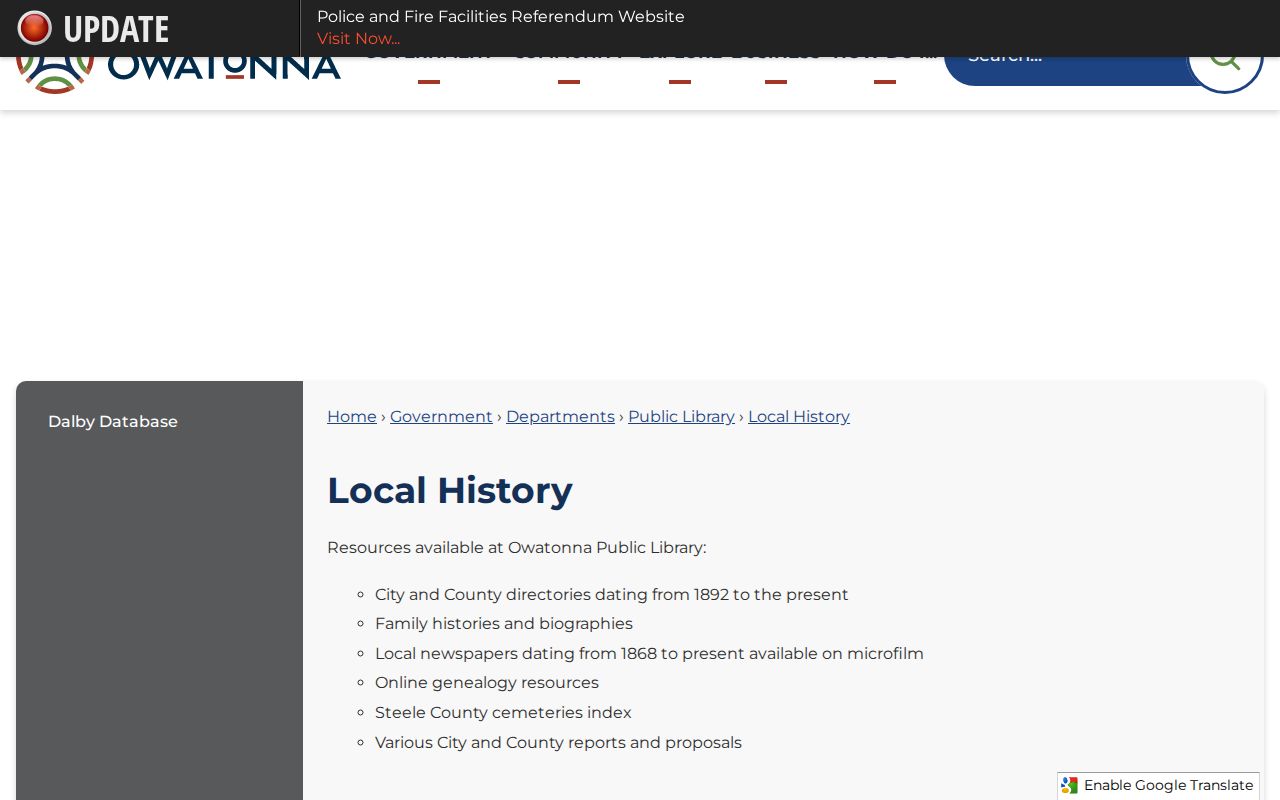
Use the Owatonna local-history desk to confirm a volume before treating a broad collection description as a year-by-year inventory.
Note: An Owatonna directory year and a census year describe different dates, so preserve both dates in a household timeline.
Owatonna Research Room
The Steele County Historical Society research room is the practical Owatonna fallback when a library run has a gap or an older address needs local context. Its Zamboni Genealogy and Research Room lists Polk City Directories, county plat books, family histories by surname, oral histories, obituary and collection databases, the Dalby Database, and Ancestry access. Members enter free; nonmembers pay $5. Call 507-451-1420 ahead, because an appointment is recommended. Assisted research is listed at $10 per hour with a 30-minute minimum, while priority research carries separate listed rates. The Owatonna History Center is at 1700 Austin Road, and its posted hours differ from OPL hours.
Those Owatonna holdings make a useful human-use bridge. An Owatonna directory entry can point to a surname file, a plat book can explain a rural description, and an oral history may supply context that an index does not. None replaces the printed entry or recorded instrument for its own purpose.
The SCHS research page describes the materials and handling rules for the Owatonna city-directory fallback.
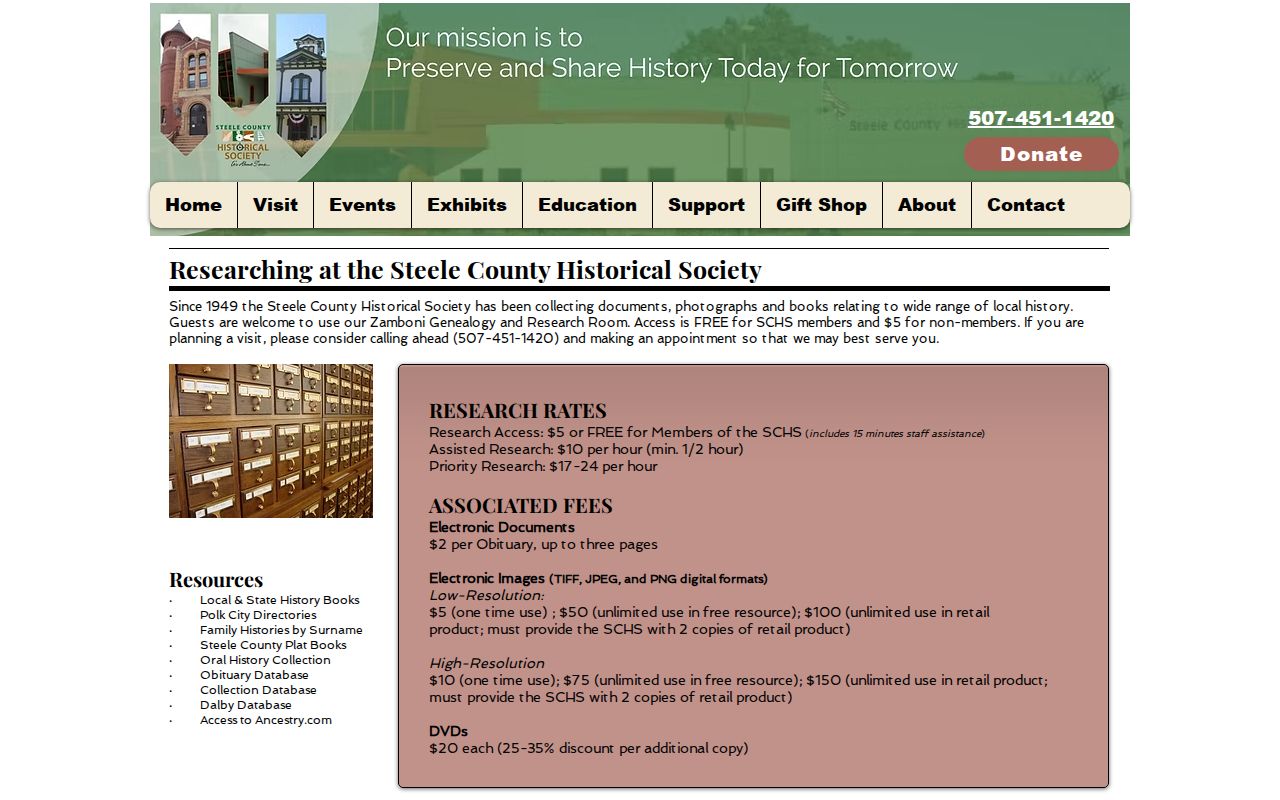
Call before an Owatonna visit so staff can explain registration, access, and whether a needed directory or related collection is ready to consult.
Reading Owatonna Directory Entries
An Owatonna city directory entry is a publisher-era statement about a name and address relationship. A typical entry may give a surname and given name, occupation or business, street address, and a residence or business marker. It is neither a deed nor a current confirmation. The exact typography, abbreviation key, and complete entry fields for an Owatonna sample were not inspected during the source session. For that reason, do not quote an unverified symbol, spouse notation, owner mark, or abbreviation as if it were printed in every local volume. Photograph or transcribe the page only after inspecting the relevant volume.
| Name | The printed surname and given name, copied with its spelling and initials. |
|---|---|
| Address | The street, rural route, or business location exactly as printed for that volume year. |
| Occupation or business | A historical clue that can lead to a newspaper, probate, family-history, or business record. |
| Residence marker | A marker that may distinguish residence from business, subject to the volume’s own key. |
| Page context | The volume year, page, heading, and adjacent entries needed to reproduce the finding. |
- Criss-cross directory
- A directory arranged by street or address rather than only by personal name. Confirm that a local volume includes one before relying on it.
- Householder index
- An index that groups a household under a named person; its arrangement can vary by publisher and year.
- Abbreviation key
- The volume’s explanation for shortened labels and markers. Read it before interpreting an entry.
Owatonna Newspaper Companions
Use a directory year with newspapers and obituaries when two households share a surname or when a person disappears between volumes. The Minnesota Historical Society’s People’s Press record identifies the daily People’s Press from 1916 to 1969 and Owatonna People’s Press from 1969 forward. The weekly People’s Press began in 1874, the daily paper began in 1916, the weekly ended in 1921, and the Owatonna Journal-Chronicle was purchased and consolidated on January 17, 1938. Search under the title used in the date range, not only the modern newspaper name.
The Clay and Steele County obituary collection covers 1865-2006 and can include relatives, newspaper/date/place, birth details, and military detail. Those fields help separate same-name people, but they should be cited as indexed obituary information rather than a replacement for the underlying notice.
The FamilySearch obituary collection provides a dated companion to an Owatonna city-directory finding.
Compare the obituary’s relatives and newspaper details with the directory year before joining two entries to one household.
Tracing Owatonna Directories
Follow a household through Owatonna city directories in dated steps. Start from the closest known printed year, not from an assumed start date. The library’s broad collection claim and the Gale runs are useful route markers, while the census and naturalization collections supply a separate household view. Minnesota Historical Society’s genealogy index identifies state census years of 1865, 1875, 1885, 1895, and 1905, and its People Search reports census coverage from 1849 through 1905. Census geography can be a township or ward rather than a modern street, so retain the original address and geographic label.
- Find the surname or printed address in the closest available volume and copy the volume year and page.
- Check the prior and next available years, marking each missing volume rather than guessing continuity.
- Compare nearby entries and any residence or business marker only under that volume’s key.
- Pair the time interval with the relevant census household, newspaper title, or cemetery and obituary source.
- Use the Recorder or a plat source only when the question becomes title or legal-description history.
A person leaving a directory can indicate a move, death, business change, omission, or simply a missing volume. It does not answer which explanation applies without another dated source.
Owatonna Directory Timeline
Owatonna’s record setting explains why a city-directory search often needs more than one shelf. The city was laid out in 1856 and the railroad reached the town in 1866. Owatonna Public Library opened on February 22, 1900, after the local directory run had already begun. County-court naturalization holdings run from 1853 to 1954, overlapping much of the directory era and offering name variants or residence clues for immigrant households. For later federal naturalizations, custody changed toward NARA after county courts stopped handling them.
| 1853-1954 | Steele County District Court naturalization holdings documented by the MNHS finding aid. |
|---|---|
| 1892-present | OPL’s stated city and county directory collection span, subject to exact-volume confirmation. |
| 1900 | Owatonna Public Library opened, creating a long-running local research gateway. |
| 1940/41-1947/48 | Gale’s “Owatonna City” run, with 1942-1946 marked missing. |
| 1950-1959 | Gale’s “Owatonna” run, with five listed missing years. |
Note: A collection date, publication date, and online availability date are different facts and should not be treated as one coverage claim.
Owatonna Historical Records Limits
Older Owatonna entries may use rural routes, a street form that changed, or a location outside a later city boundary. No official street-renumbering year or full renaming schedule was located, so a modern address should not be silently projected backward. Compare the printed address with a plat, legal description, township census reference, later postal form, or annexation record. The city’s annexation history also shows that a property can shift from township context to city context over time. For a current parcel question, use the modern records chain rather than a historical directory entry.
Owatonna’s 2021 boundary map uses township and section context beside streets and I-35. That makes it a useful geography check when a printed directory describes a place as rural, but the map does not establish a resident, title, or exact address conversion.
Historical directory research stays strongest when it preserves uncertainty: name spelling, date, source title, page, and the difference between listed address, legal title, and present residence. The current address-record path is handled on the Owatonna street directory page.